Pages

Wednesday, November 5, 2014

The Knights Errant Part 2


As mentioned in the previous post, the Knight's Errant that we see today was not what Sir John Everett Millais originally painted. In his original painting the woman was facing the knight, because of this, many believed this expressed the woman's 'loose morals'. In response to this, Millais cut out the torso of the woman and repainted it to have her looking away from the knight, showing modesty.


The original cut out torso of the woman was reused for another of Millais' paintings 'The Martyr of The Solway'

Crystal Palace: The Great Exhibition


This is a painting by Joseph Paxton of the Crystal Palace in London during the Great Exhibition in 1851. The Great Exhibition was the first international exhibition of manufactured products and represented the British Empire being the center of industrialization. Crystal Palace occupied nineteen acres of land and approximately six and a half million people visited the exhibition, dimensions that the world had never seen before. 

Wednesday, October 29, 2014

The Knight's Errant

Overall
                This oil painting depicts a typical chivalrous knight helping a damsel in distress. In this almost life sized painting, an armor clad knight is freeing a stripped, defenseless women who was attacked and kidnapped. The knight’s sword is covered in blood and the assumed attacker’s corpse can be seen behind him. The tree the woman is tied to is a Silver birch, which at the time, was identified with the female gender; being referred to as “Lady Birch”.  
About the Artist
                The artist: Sir John Everett, Millais was born June 8th 1829. He was a child prodigy; he attended Sass's Art School in London and won a silver medal at the Society of Arts at the age of nine.
Reception
Because of the female nudity of the painting, it was given very critical reviews.  A lot of this critic was on Millais’ treatment of the woman.  Critics thought that this was an attempt to idealize nudity and place it in a classical (Greek or Roman) setting. Millais was actually trying emulate an early Victorian style of painting started by artist William Etty. Etty’s was known for his nude paintings but what Millais really admired was the techniques and rich colors Etty used. Stangely enough one of the main critics of the paintings was that the woman was too “life-like”.  “the manner is almost too real for the treatment of the nude” (quoted in Nead p.235 of the June 1870 Art Journal).  Not only that but some questioned the woman’s morals. Because of this as well as the fact that the painting wasn’t selling, Millais cut the head and torso off the painting. He then repainted the woman to be looking way to make her appear more modest. The portion of the painting cut out was reused in another painting a year later. After the revision, the painting was sold in 1874.
How it Connects to empire
The first thing is the controversy that was caused by the nudity of the woman. Due to the more conserved nature of the English more importantly English women, nudity was mostly connected with savages. Although it is made clear in the painting that the woman was nude because she was attacked, critics still questioned and assumed the woman’s morals.
Next is the literal name of the painting.  The Knight’s Errant is the adventure a knight goes on in search of people to help. This can be somewhat connected to how the English “help” other countries such as India. Because the English identify themselves as basically the ‘pinnacle of society’ it is their duty to help others. One of these means of “help” would be the missionaries that went around spreading (forcing) Christianity onto others. Similar to Ms. Clack in the Moonstone
 Work Cited

  • Virag, Rebecca. "Sir John Everett Millais, Bt, 'The Knight Errant' 1870." Tate. N.p., Mar. 2001. Web. 20 Oct. 2014.
  • Riggs, Terry. "Sir John Everett Millais, Bt, 'Ophelia' 1851-2." Tate. N.p., Jan. 1998. Web. 20 Oct. 2014.

Artifact of Empire Project - Jane Eyre and the Great Famine (1840s)

Jane Eyre and the Great Famine


Artifact of Empire: 1840s
Artifact: Newspaper advertisement.
   ➢ Author: William Little; British Association for the Relief of Extreme Distress in the Remote Parishes of Ireland and Scotland
   ➢ Publication date: Saturday, January 16, 1847
   ➢ Publication location: 198 Strand, Parish of St. Clemens, Danes, London, UK
   ➢ From: The Illustrated London News (Historical Archive 1842 – 2003)
   ➢ URL: http://0-find.galegroup.com.helin.uri.edu/iln/infomark.do?&source=gale&prodId=ILN&userGroupName=mlin_s_wheaton&tabID=T003&docPage=article&docId=HN3100016223&type=multipage&contentSet=LTO&version=1.0

What is it?
Taken from a 1847 edition of the London Illustrated News, this newspaper advertisement from the British Association for the Relief of Extreme Distress in the Remote Parishes of Ireland and Scotland announces the launch of a new committee dedicated to helping the thousands of individuals suffering from the harrowing effects of the Great Irish Potato Famine. Before elaborating on the finer details, the advertisement provides rudimentary list of committee members who have already established interest in the endeavor in an effort, presumably, to demonstrate its credibility. From there, the piece invites “benevolent persons” to donate money towards the cause, with the unspoken promise that their names will be added to the public list of benefactors that follows. Occupying the center column, the advertisement draws attention away from the surrounding bulletins that offer various consumer goods like “American Soda Biscuits” or “Burdoe’s Winter Over-Coats.” The paper’s vertical orientation distinguishes it from other publications at the time by permitting a wider variety of content.

Context
An influx of new technologies that appeared around the early 1800s sparked the beginning of Britain’s Industrial Revolution, causing thousands of rural workers to flock to the city in search of jobs (History.com). In 1815, Parliament passed a series of agricultural laws, titled the Corn Laws, that prevented the importation of foreign corn, forcing higher food prices on these new urban families, benefitting the wealthy landowners, and thus widening the wealth gap. In Ireland, the reliance on Aran potatoes, which often yielded more crop and greater income, was interrupted by the onset of blight, a harsh fungus that wiped out the country’s potato supply. With the depletion of their major crop, Ireland was left destitute and hungry. Prime Minister and ex-Chief Secretary of Ireland Robert Peel shared the sentiment that the Irish were simply exaggerating the problem (O'Rourke) and, in turn, offered government stipends for food to Irish workers who were willing to partake in tedious tasks. The effort resulted in the death of millions, as starving workers struggled to survive until their next weekly paycheck. Though Peel’s successor, Lord John Russell, provided some relief with the construction of soup kitchens and loan centers, the flood of people to urban areas to receive these benefits resulted in epidemics that killed more people than the famine itself (Victorian Web). By the end of 1850, the massive shift in food production caused by English Corn Laws paired with the turmoil caused by the Irish Potato Famine had triggered a fixation with hunger across the United Kingdom, one that seeped into the pages of the period’s emerging literature.

Relation to Text
In Charlotte Bronte’s Jane Eyre, the protagonist’s experiences at the Lowood School channel the famine spreading across the neighboring parishes of Ireland and Scotland. A few weeks into her stay at the Lowood School, Jane begins to feel the effects of Lowood’s paltry living conditions, noting: “The scanty supply of food was distressing […] whenever the famished great girls had an opportunity, they would coax or menace the little ones out of their portion […] after relinquishing to a third [girl] the contents of my mug of coffee, I have swallowed the remainder with an accompaniment of secret tears, forced from me by the exigency of hunger” (122). Though partially a byproduct of neglect, the hunger that spreads throughout Jane’s class mirrors the hunger and desperation that was plaguing the country at the time.

In both Jane Eyre and the newspaper clipping, the aid of outside sources comes with the formation of a committee dedicated to correcting the problems of the poor. In presenting the goals for the proposed committee, the British Association notes how they “prefer to act on the strong conviction that there are a large number of benevolent persons fully acquainted with the distress and ready to bestow their bounty whenever a channel is presented to them” (Illustrated London Press). In other words, the British Association aimed to improve the food crisis by establishing a committee run by “benevolent persons.” Likewise, the Lowood school became “a truly useful and noble institution” thanks to help from generous benefactors: “Several wealthy and benevolent individuals in the county subscribed largely for the erection of a more convenient building in a better situation; new regulations were made; improvements in diet and clothing introduced; the funds of the school were entrusted to the management of a committee” (149). In this way, Jane Eyre reflects the approach to poverty and famine adopted by the British during the Great Famine.

Just as upper classes in the 1840s feared hunger-induced riots, Lowood receives negative attention from the public when its poor provisions are exposed. In her retrospective account of her eight years at Lowood, Jane points out how eventually, “inquiry was made into the origin of the scourge, and by degrees various facts came out which excited public indignation in a high degree” (149). The efforts made, through the establishment of committees and donation funds, to quell the hunger epidemic sprang from the self-preservation instincts of the upper class, who aimed to avoid the potential “indignation” that ignoring the crisis would (and did) inspire. Such efforts are reflected in Jane Eyre in the community’s outrage against the Lowood school’s inadequate meals.

Perhaps most significantly, Jane appears to act as the mouthpiece for Charlotte Bronte’s views on the impoverished communities described in the 1847 newspaper ad. When Mr. Lloyd questions Jane about her life at Gateshead, she notices the poor beggars lingering outside of the doors and muses, “poverty looks grim to grown people; still more so to children: they have not much idea of industrious, working, respectable poverty” (82). To many, the working class appear ragged and display “rude manners” or “debasing vices” (82) and are promptly ignored. Bronte’s character, and the newspaper clipping, strive to achieve the same goal: to correct this view of the poor by eliminating hunger and returning to them a degree of self-sufficiency.

Related Links

Works Cited
Bronte, Charlotte. Jane Eyre.: Smith, Elder, and Company, 1847. Print. 
"Industrial Revolution." History.com. A&E Networks, n.d. Web.      17 Sept. 2014. http://www.history.com/topics/industrial-revolution
Little, William. British Association for the Relief of Extreme Distress in the Remote Parishes of Ireland and Scotland. Advertisement. Illustrated London News [London] 16 Jan. 1847: Print.
O'Rourke, John. The History of the Great Irish Famine of 1847. 2004. Digital file.
Victorian Web. George P. Landow, 8 May 2009. Web. 17 Sept. 2014. <http://www.victorianweb.org/ science/health/hunger.html>. 
 

Artifact of Empire 1880s

"The Nemesis of Neglect"


What is it?
This artifact is an illustration of the infamous serial killer Jack the Ripper, the serial killer who terrorized the streets of Whitechapel in the year 1888. In this depiction, Jack is portrayed like a ghost, haunting the neighborhood; he is transparent and floating as well as having a ghoulish visage which depicts him as inhuman rather than as an ordinary person (because of this, he becomes more of a character than any person out loose on the streets of London). He is even described as a “phantom” and “spectre” in the picture’s caption. His cape – which symbolically serves as a veil of his identity – is branded with the text “CRIME,” a generalization which pictures Jack as only one aspect of the crime within London, not as the only source of it no matter how astonishing his crimes may be.  His background also hints at there being a problem with the bigger picture of London and extending it beyond one brutal murderer. The street is drawn as dark and unfriendly with broken bottles of what looks to be alcohol and shattered plates littering the streets while windows are either shattered or boarded up, portraying the nasty conditions of Whitechapel and the lack of care and notice taken for the area up until this point. Lastly, the ghoulish Jack is shown as being able to walk right up to the doorsteps of this neighborhood brandishing a rather large sharpened blade. This all ties in with the bolded title “NEMESIS OF NEGLECT” at the image’s base; the illustration censures the neglect Britain has for the poor neighborhoods such as Whitechapel and actively characterizes a nameless threat as a predator on this negligence in order to emphasize the real threat: Britain’s neglect.

Context

The illustration provides readers of Punch with a reason to question the wholesome Christian Empire that Britain portrayed itself to be during the Victorian Age. As with the previous decades, the Empire set itself on a pedestal as the prime example of order and prestige. Punch satirizes the horror of the five gory Whitechapel murders to ridicule Britain’s control over their own nation and criticize the way the Empire pictures itself. Upon looking at this image, however, readers do not see order let alone anything to be proud of. The portrayal of the Ripper as a ghost not only paints him as mysterious and haunting but also as elusive; for an empire in control of colonies extending into the Orient and in possession of a great deal of power, it is disgraceful, as portrayed here, that it cannot catch even one fiend such as Jack the Ripper who went as far as taunting police with gruesome notes recounting his pleasure taken in slaughtering the five women.

            Punch also criticizes the juxtaposition between how Britain boasts itself to be and the reality of life in the Empire. The setting of the illustration is not something to be proud of; in fact, the streets of Whitechapel have been known to have been the homes to many shifty and/or impoverished characters at the time, many of which were also immigrants. The five victims had been known as drinkers and morally questionable, and Mary Kelly had emigrated from Ireland before she had been slaughtered in her own residence. Also, she was the only one of the five to be brutalized inside and not in the streets, another detail to shock the public; not only had “CRIME” invaded their streets but it had also entered their households and brought along an onslaught of overkill and mutilation. This horror serves as a great contrast to the highly moral character the Empire prided itself in at the time, countering Victorian Values with Jack’s bloody reign of terror.

            The satire of Punch in relation to this image serves to show the duplicity and deception of the British Empire which used such cunning moves to advance its influence in the world. One on hand there is the caring Christian nation spreading its values to the “unfortunate” Orient with missionaries and their values, but on the other remains the nation itself which has plummeted into a state of chaos and terror all while the Empire denies the world of this truth.

How Does it Relate to What We’ve Read in Class?

            The reason this image applies to Robert Louis Stevenson’s The Strange Case of Dr Jekyll and Mr Hyde and is included as part of Appendix J is that there are strong parallels to the motif of duplicity and hidden dark sides in both cases. Dr. Jekyll and Mr. Hyde both symbolize a different side of the British Empire. Jekyll represents how Britain portrays itself; both have good reputations and relations within society and serve as helpers to man (in Jekyll’s case, he is a doctor and a healer whereas Britain is a missionary). In contrast, Hyde represents how the facts and cases such as Jack the Ripper’s portray Britain; both Hyde and the Empire step on the innocence of others to get where they are going. On page 33 of the narrative, Hyde “trampled calmly over the child’s body;” here, the child symbolizes innocence which is being overlooked in order for Hyde to heartlessly continue with his own plan. Britain may also be described as a “Juggernaut” (33) over the Orient, preying upon the innocence and lesser strength of the nation to conquer land in order to preserve its values and power. This connects to Darwin’s idea of adaptation with Britain adapting to its role as a great force in the Victorian Era and having the Orient fall behind as the region struggles to adapt to Britain’s force, technology, and scientific advances.

            The setting of the image also parallels the description of Soho given on page 48 of Stevenson’s narrative. The “rugged children huddled in the doorways, and many women of many different nationalities” reflects the conditions of Whitechapel and the sorts of people found there. These doorsteps mentioned are picture in the image above and, by connecting both the passage and the image, it is implied that these women, children, and nationalities are at risk due to the neglect Britain places on the poor and foreign. Punch and Stevenson heavily emphasize the dual identity of the Empire in these ways, portraying Britain like a bold missionary on the outside but a neglectful parent to its people on the other.
Other Artifacts
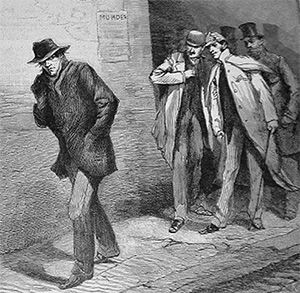
One of a series of images from the Illustrated London News for October 13, 1888 carrying the overall caption, "With the Vigilance Committee in the East End". This specific image is entitled "A Suspicious Character".
"With the Vigilance Committee in theEast End" from the Illustrated London News on October 13, 1888 (http://www.historytoday.com/william-d-rubinstein/hunt-jack-ripper)
Citations
Stevenson, Robert Louis, and Martin A. Danahay. The Strange Case of Dr. Jekyll and Mr. Hyde.2nd ed. Peterborough, Ont.: Broadview Press, 2005. Print.
"The Nemesis of Neglect." Punch 29 Sept. 1888: 152. Print.
Other Sources


"Europe PubMed Central." The Whitechapel murders: the case of Jack the Ripper.. N.p., n.d. Web. 27 Oct. 2014. <http://europepmc.org/abstract/MED/7030054>.

"Punch." Google Books. N.p., n.d. Web. 27 Oct. 2014. <http://books.google.com/books?id=MAYDAAAAIAAJ&pg=RA1-PA102&dq=punch+september+1888&hl=en&sa=X&ei=TAhIVIOOBpPnsASIo4GYCg&ved=0CEsQ6AEwBg#v=onepage&q=nemesis%20neglect&f=false>.

Handkerchief of Empire

What is it?
My artifact is a handkerchief that was made to commemorate the Diamond Jubilee of Queen Victoria, an event that marked the sixtieth anniversary of her reign. The handkerchief is made from linen and is embellished with a black roller print design, indicating that it was probably mass-produced to be bought by all socio-economic classes. The design of the handkerchief depicts the British Empire and her various technological inventions through a series of icons laid out in concentric circles. Outside the outermost circle are coats of arms representing the imperial holdings of Canada, India, Australia, and Africa. Within the outermost circle are icons symbolizing the major industrial inventions of the nineteenth century. The inventions represented here include the railroad, the printing machine, the telegraph, the Maxim gun, and the battleship, the HMS Majestic. Finally, the innermost circle depicts Queen Victoria herself.

Context
The imagery on the handkerchief tells a triumphant story of British imperial might. First, the design of concentric circles evokes the globe, a reminder that British power extended to all corners of the earth in 1897. By having Queen Victoria in the center circle and the British colonies at the periphery of the outer circle, the handkerchief reinforces the idea that Queen Victoria—and, by extension, Great Britain—was the central authority overseeing the far reaches of the British Empire. The outer circle, which depicts British technological innovations, gives a sense of how British power was maintained despite the vast oceans separating England and her colonies. The telegraph and printing press, for instance, opened more efficient lines of communication between England and her imperial holdings. As the historian Ronald Hyam notes about the telegraph in particular, “The one triumphantly unifying factor [of the empire] was cable construction...: ‘the nerves of the empire’, by the 1890s, girdled the world with 121,000 miles of telegraph wires.” In a similar manner, technologies of travel such as the railway strengthened British power abroad by making it easier for government agents and soldiers to reach colonial outposts quickly and efficiently. The Maxim gun and the HMS Majestic shown on the handkerchief symbolize the unrivalled military might of Britain during this time period. For instance, the Maxim gun, a machine gun described as “frightfully destructive” by its inventor, changed the face of imperial warfare. Emily S. Rosenberg observes that the gun “emerged as a potent weapon in ‘little wars’ that were fought on colonial frontiers, where small British forces sought to imprint their authority over large areas and the substantial armies that tribal leaders could muster.” In sum, this commemorative handkerchief functions as a piece of imperial propaganda. It celebrates territorial conquests made by Britain, and details those inventions which permitted the further expansion and consolidation of the British Empire.

The Maxim machine-gun was adopted by the British Army in 1889.


How Does it Relate to Nineteenth-Century Literature?
The handkerchief’s representation of imperial might, I believe, resonates with Rudyard Kipling’s depiction of empire in “The White Man’s Burden.” Kipling alludes to the violence involved in maintaining imperial power when he writes, “Take up the White Man’s burden--/ The savage wars of peace” (lines 17-18). Similarly, the Maxim gun and the HMS Majestic on the handkerchief reminds one of the horrific violence and destruction involved in maintaining British authority over her colonies. Furthermore, I see a relationship between Kipling’s depiction of colonized people as “silent” (line 47) and the fact that Africa, India, Australia, and Canada are represented by their coats of arms on the handkerchief. By representing these territories by their British-bestowed symbols, the handkerchief works to “silence” the voices of colonized people. In other words, the indigenous cultures of Africa, India, Australia, and Canada are not represented in the handkerchief’s narrative of empire; rather, these cultures are symbolically assimilated into British culture and British political structures. However, there is a crucial difference in tone between Kipling’s depiction of empire and the handkerchief’s. Where Kipling appears to critique practices of imperialism in his poem, the handkerchief unapologetically celebrates empire and imperialism.


Works Cited
  • Ronald Hyam, Understanding the British Empire (Cambridge: Cambridge University Press, 2010), 19.
  • Qtd. in J. Bucknall Smith, “Illustrated Interviews: No. XXXVIII—Mr. Hiram S. Maxim,” The Strand Magazine, 8 (July-December 1894), 584.
  • Emily S. Rosenberg, A World Connecting: 1870-1945 (Cambridge, MA: Harvard University Press & C.H. Beck Verlag, 2012), 359.
More Information

Handkerchief. Creator unknown. Made in Britain, 1897. Found on ArtStor.org.

Oh.. Victorians

Haha