Pages

Showing posts with label Queen Victoria. Show all posts

Wednesday, October 29, 2014

Handkerchief of Empire

What is it?
My artifact is a handkerchief that was made to commemorate the Diamond Jubilee of Queen Victoria, an event that marked the sixtieth anniversary of her reign. The handkerchief is made from linen and is embellished with a black roller print design, indicating that it was probably mass-produced to be bought by all socio-economic classes. The design of the handkerchief depicts the British Empire and her various technological inventions through a series of icons laid out in concentric circles. Outside the outermost circle are coats of arms representing the imperial holdings of Canada, India, Australia, and Africa. Within the outermost circle are icons symbolizing the major industrial inventions of the nineteenth century. The inventions represented here include the railroad, the printing machine, the telegraph, the Maxim gun, and the battleship, the HMS Majestic. Finally, the innermost circle depicts Queen Victoria herself.

Context
The imagery on the handkerchief tells a triumphant story of British imperial might. First, the design of concentric circles evokes the globe, a reminder that British power extended to all corners of the earth in 1897. By having Queen Victoria in the center circle and the British colonies at the periphery of the outer circle, the handkerchief reinforces the idea that Queen Victoria—and, by extension, Great Britain—was the central authority overseeing the far reaches of the British Empire. The outer circle, which depicts British technological innovations, gives a sense of how British power was maintained despite the vast oceans separating England and her colonies. The telegraph and printing press, for instance, opened more efficient lines of communication between England and her imperial holdings. As the historian Ronald Hyam notes about the telegraph in particular, “The one triumphantly unifying factor [of the empire] was cable construction...: ‘the nerves of the empire’, by the 1890s, girdled the world with 121,000 miles of telegraph wires.” In a similar manner, technologies of travel such as the railway strengthened British power abroad by making it easier for government agents and soldiers to reach colonial outposts quickly and efficiently. The Maxim gun and the HMS Majestic shown on the handkerchief symbolize the unrivalled military might of Britain during this time period. For instance, the Maxim gun, a machine gun described as “frightfully destructive” by its inventor, changed the face of imperial warfare. Emily S. Rosenberg observes that the gun “emerged as a potent weapon in ‘little wars’ that were fought on colonial frontiers, where small British forces sought to imprint their authority over large areas and the substantial armies that tribal leaders could muster.” In sum, this commemorative handkerchief functions as a piece of imperial propaganda. It celebrates territorial conquests made by Britain, and details those inventions which permitted the further expansion and consolidation of the British Empire.

The Maxim machine-gun was adopted by the British Army in 1889.


How Does it Relate to Nineteenth-Century Literature?
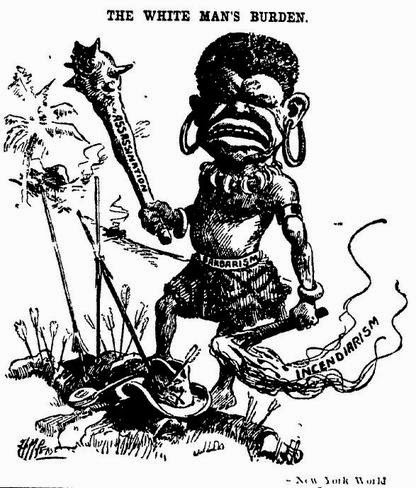
The handkerchief’s representation of imperial might, I believe, resonates with Rudyard Kipling’s depiction of empire in “The White Man’s Burden.” Kipling alludes to the violence involved in maintaining imperial power when he writes, “Take up the White Man’s burden--/ The savage wars of peace” (lines 17-18). Similarly, the Maxim gun and the HMS Majestic on the handkerchief reminds one of the horrific violence and destruction involved in maintaining British authority over her colonies. Furthermore, I see a relationship between Kipling’s depiction of colonized people as “silent” (line 47) and the fact that Africa, India, Australia, and Canada are represented by their coats of arms on the handkerchief. By representing these territories by their British-bestowed symbols, the handkerchief works to “silence” the voices of colonized people. In other words, the indigenous cultures of Africa, India, Australia, and Canada are not represented in the handkerchief’s narrative of empire; rather, these cultures are symbolically assimilated into British culture and British political structures. However, there is a crucial difference in tone between Kipling’s depiction of empire and the handkerchief’s. Where Kipling appears to critique practices of imperialism in his poem, the handkerchief unapologetically celebrates empire and imperialism.


Works Cited
  • Ronald Hyam, Understanding the British Empire (Cambridge: Cambridge University Press, 2010), 19.
  • Qtd. in J. Bucknall Smith, “Illustrated Interviews: No. XXXVIII—Mr. Hiram S. Maxim,” The Strand Magazine, 8 (July-December 1894), 584.
  • Emily S. Rosenberg, A World Connecting: 1870-1945 (Cambridge, MA: Harvard University Press & C.H. Beck Verlag, 2012), 359.
More Information

Handkerchief. Creator unknown. Made in Britain, 1897. Found on ArtStor.org.

Scarf from Queen Victoria's Diamond Jubilee

Artifact: Commemorative Scarf from Queen Victoria's Diamond Jubilee.
Date: 1897
Producer: Unknown
Material: White china silk


What is it?

The artifact I chose is a scarf made in 1897 that was intended to commemorate Queen Victoria’s Diamond Jubilee. The manufacturer of the artifact is unknown but the scarf is made from white china silk. The center of the scarf depicts three images of Queen Victoria. One portrait is from the beginning of her reign, one is from the middle, and one is from the time of the Jubilee. There is script above and below these images. The top portion reads “Her Gracious Majesty Victoria” and the portion below reads, “Queen of Great Britain and Empress of India”. Along the border of the scarf are the names of the 24 countries that were members of the British Empire at the time. A particular focus is given to India, England, Scotland, and Ireland as these countries make up the corners and are particularly embellished with decorative coats of arms.
Context
The Diamond Jubilee was an event celebrated not just in England, but internationally as well. It took place on June 22, 1897 and was a 6-mile procession through the streets of London featuring 17 carriages and representatives from all of Victoria’s dominion countries. Particularly prominent were the Indian cavalry that escorted Victoria’s carriage. In short, the event was a blatant display of imperialism, as Victoria literally paraded her colonies around London in an attempt to show her people, and the rest of the world, how strong the British Empire actually was.
            The images presented on the scarf symbolically reflect these ideas of imperialism and British power. Victoria herself serves as the focal point of the scarf, indicating that she remains the most important part of the empire. In addition, laurel wreaths surround her images and she is depicted wearing crowns and jewelry, reflecting the Empire’s wealth and prosperity. In contrast, the colonies are shown on the outer borders of the scarf, indicating that they are of lesser importance than England. It is also interesting to note which countries were positioned in the corners of the scarf. Scotland, England, Ireland, and India were given special attention and the designs for these countries are especially ornate. It’s possible that these countries were seen as the most relevant and important colonies to England. Scotland and Ireland are close to England geographically and have long histories with England so it makes sense that the English would see them as important. India, however, was a fairly recent acquisition, Victoria was crowned Empress of India in 1877, but it was still seen as important enough to take up a corner of the scarf. This is because India was seen as the “jewel in the crown” and was highly valued by England for the resources it provided. Interestingly, one of the most valued resources extracted from India was silk, since India had access to silk from China. Ironically, this scarf is made from silk that was probably from India. So this scarf, which portrays the imperialistic relationship between England and India, is made from a resource received directly from that imperialism.
            By creating this scarf and then selling it as a souvenir, the manufacturer effectively trivializes the important issues associated with imperialism. England was proud of their colonies and viewed them as possessions, ignoring the harmful effects that their influence had on the colonies. The English were so proud of their vast empire that they purchased and wore a scarf that bragged about their colonial acquisitions.
Relation to Text
In a general sense, the ideas of imperialism represented in the scarf relate to the themes of imperialism that are present in all of the texts we’ve read in the course. Specifically, it connects with The Moonstone, as that novel criticizes the imperialistic relationship between England and India. In the novel, most of the story takes place in England, which reaffirms the assertion on the scarf that England is the central and most important part of the empire. There could also be a connection between the actual Moonstone, which is a cursed Indian jewel, and the idea that India was considered “the jewel in the crown”. In The Moonstone, the jewel is extremely important and valued in India for its religious importance. However, when the English take it, it becomes cursed and is the center of a crime scene. Perhaps Collins is playing with the metaphor of India being a jewel but is suggesting a darker relationship between the two countries. While Collins criticizes the imperial relationship between England and India, the scarf does the opposite.
            I also see a relationship between the ideas presented in the scarf and the philosophy of Herbert Spencer. Spencer argued that it was natural for societies to grow more complex and advanced with time. He writes, “The orderly progress from simplicity to complexity, displayed by bodies-politic in common with living bodies, is a characteristic which distinguishes living bodies from the inanimate bodies amid which they move” (Spencer 9).  He claims it is “orderly” for societies to become more complex. He later distinguishes between savage and civilized societies, arguing that civilized societies continue to grow, “In complexity, our large civilized nations as much exceed primitive savage tribes” (Spencer 9). The imagery on the scarf seems to agree with this idea. Spencer’s theory somewhat justifies the ideas of imperialism. It is likely that the British saw their massive and always expanding empire as natural and even a sign of civilization. If they believed this, then it would have been easy to justify wearing a scarf that blatantly promoted imperialism.

Artifact Link: http://0-library.artstor.org.helin.uri.edu/library/welcome.html#3%7Csearch%7C6%7CAll20Collections3A20victoria20diamond20jubilee%7CFiltered20Search%7C%7C%7Ctype3D3626kw3Dvictoria20diamond20jubilee7Call26geoIds3D26clsIds3D26collTypes3D26id3Dall26bDate3D26eDate3D26dExact3D26prGeoId3D26origKW3Dvictoria20diamond20jubilee7Call