Pages

Showing posts with label british empire. Show all posts

Sunday, November 9, 2014

Artifact of Empire - 1830s

Artifact: Oil Painting. Creator: Alexander Rippingille. Made in Bristol, Britain. 1834. Found on ArtStor.org
From: Image of the Black in Western Art: Harvard University

What is it?
My artifact is an oil painting that was made to commemorate and comment on the emancipation of slaves in the colonies of the British Empire. The Act for the Abolition of Slavery was given Royal Assent on August 1st 1833. The painting, made circa 1834, shows a black slave family burying their shackles and holding up their arms in a gesture of gratitude. It is a one of a kind, unique painting made from oils on a canvas. The painting, entitled: To the Friends of Negro Emancipation, is an homage, and congratulatory work, for those who were part of the fight to push through the Act of Emancipation in 1833, and all the years in its prelude. The title might refer to those white Europeans who fought for the slaves, but the image itself is a congratulations to the blacks who were able, from then on, to cast off their shackles and never submit to white oppression again. Rippingille must have felt some sympathy for the slaves, otherwise, would he have painted such an image?

Context
Apart from India, whose laws fell under the ruling of the East India Company, the British colonies were to release all slaves and indentured servants from holding. This image of celebration captures a historic and politically charged event. The white slaver and slave owner lost a considerable amount of stock, in terms of produce, work force, investment and of course, money. The white man, in the colonies, would probably not have been happy at the emancipation of his slaves. Abolitionism was more of a domestic triumph of human rights and morals.
The industrial revolution, that began in Britain around 1750, provided an exponential increase in wealth, productivity, power and influence for the country. The British Empire had already existed for over a hundred years, the East India Company having established roots in India in the mid-1600s, but colonization of most of the Empire happened in the 1700s and 1800s. To further their goals of domination and wealth, the British established a slave trade to rival that of the Arabs (who dominated the east coast of Africa). Such slaves were captured on the West African coast, stowed on slave ships and delivered to colonies in the West Indies and the 13 American Colonies in exchange for financial and exotic produce including Tabaco and sugar cane.
In 1807, the Slave Trade was abolished. Slaves were no longer being taken from Africa by British ships. By 1823, the first Anti-Slavery Association was formed for the sole purpose of releasing all colony and motherland slaves from bondage.
In 1833, the emancipation bill was passed. In 1834, all slaves were totally freed from ownership, white or otherwise.

How does it relate to what we’ve read in class?
The book was published in 1847, a full 14 years after emancipation, but no direct mention of slavery occurs in Jane Eyre.. However, the character of Bertha Mason does give some insight into how people of color were portrayed in that time. Bertha is described as being a big woman, having a purple face, bloated features, thick and shaggy hair, swelled lips and wild stares. Almost as if to describe an animal (pg. 381). A creole is a derogatory term for a white-black hybrid, typically from a male plantation or slave owner and a female slave. Known as the outcast race, a creole is white enough to be accepted into British society but black enough to be treated with contempt as soon as they return home. “If they are sent to England to be educated, they are treated as gentlemen, and admitted into the best society; but when they return to the West Indies, they also return to their former position of compulsory debasement.” (Line 28-31 A View of West Indian society article) Bertha, whose mother was a creole, is at most ¾ white and a second generation creole. Yet, if she is described in such a way by a character like Jane Eyre, who is shown to be kind, learned and accepting, the colored person must have still been seen as animalistic and less than human (something which is clearly seen in the Herge comics of Tintin, even in the 1930s (100 years after emancipation)).
The black person, or former slave, remains in a down cast light even after s/he is freed.


"To The Friends of Negro Emancipation" - Alexander Rippingille on the Abolitionism Act of 1833


               Artifact of Empire 1830s from Tom Rosenzweig

Wednesday, October 29, 2014

Artifact of Empire 1880s

"The Nemesis of Neglect"


What is it?
This artifact is an illustration of the infamous serial killer Jack the Ripper, the serial killer who terrorized the streets of Whitechapel in the year 1888. In this depiction, Jack is portrayed like a ghost, haunting the neighborhood; he is transparent and floating as well as having a ghoulish visage which depicts him as inhuman rather than as an ordinary person (because of this, he becomes more of a character than any person out loose on the streets of London). He is even described as a “phantom” and “spectre” in the picture’s caption. His cape – which symbolically serves as a veil of his identity – is branded with the text “CRIME,” a generalization which pictures Jack as only one aspect of the crime within London, not as the only source of it no matter how astonishing his crimes may be.  His background also hints at there being a problem with the bigger picture of London and extending it beyond one brutal murderer. The street is drawn as dark and unfriendly with broken bottles of what looks to be alcohol and shattered plates littering the streets while windows are either shattered or boarded up, portraying the nasty conditions of Whitechapel and the lack of care and notice taken for the area up until this point. Lastly, the ghoulish Jack is shown as being able to walk right up to the doorsteps of this neighborhood brandishing a rather large sharpened blade. This all ties in with the bolded title “NEMESIS OF NEGLECT” at the image’s base; the illustration censures the neglect Britain has for the poor neighborhoods such as Whitechapel and actively characterizes a nameless threat as a predator on this negligence in order to emphasize the real threat: Britain’s neglect.

Context

The illustration provides readers of Punch with a reason to question the wholesome Christian Empire that Britain portrayed itself to be during the Victorian Age. As with the previous decades, the Empire set itself on a pedestal as the prime example of order and prestige. Punch satirizes the horror of the five gory Whitechapel murders to ridicule Britain’s control over their own nation and criticize the way the Empire pictures itself. Upon looking at this image, however, readers do not see order let alone anything to be proud of. The portrayal of the Ripper as a ghost not only paints him as mysterious and haunting but also as elusive; for an empire in control of colonies extending into the Orient and in possession of a great deal of power, it is disgraceful, as portrayed here, that it cannot catch even one fiend such as Jack the Ripper who went as far as taunting police with gruesome notes recounting his pleasure taken in slaughtering the five women.

            Punch also criticizes the juxtaposition between how Britain boasts itself to be and the reality of life in the Empire. The setting of the illustration is not something to be proud of; in fact, the streets of Whitechapel have been known to have been the homes to many shifty and/or impoverished characters at the time, many of which were also immigrants. The five victims had been known as drinkers and morally questionable, and Mary Kelly had emigrated from Ireland before she had been slaughtered in her own residence. Also, she was the only one of the five to be brutalized inside and not in the streets, another detail to shock the public; not only had “CRIME” invaded their streets but it had also entered their households and brought along an onslaught of overkill and mutilation. This horror serves as a great contrast to the highly moral character the Empire prided itself in at the time, countering Victorian Values with Jack’s bloody reign of terror.

            The satire of Punch in relation to this image serves to show the duplicity and deception of the British Empire which used such cunning moves to advance its influence in the world. One on hand there is the caring Christian nation spreading its values to the “unfortunate” Orient with missionaries and their values, but on the other remains the nation itself which has plummeted into a state of chaos and terror all while the Empire denies the world of this truth.

How Does it Relate to What We’ve Read in Class?

            The reason this image applies to Robert Louis Stevenson’s The Strange Case of Dr Jekyll and Mr Hyde and is included as part of Appendix J is that there are strong parallels to the motif of duplicity and hidden dark sides in both cases. Dr. Jekyll and Mr. Hyde both symbolize a different side of the British Empire. Jekyll represents how Britain portrays itself; both have good reputations and relations within society and serve as helpers to man (in Jekyll’s case, he is a doctor and a healer whereas Britain is a missionary). In contrast, Hyde represents how the facts and cases such as Jack the Ripper’s portray Britain; both Hyde and the Empire step on the innocence of others to get where they are going. On page 33 of the narrative, Hyde “trampled calmly over the child’s body;” here, the child symbolizes innocence which is being overlooked in order for Hyde to heartlessly continue with his own plan. Britain may also be described as a “Juggernaut” (33) over the Orient, preying upon the innocence and lesser strength of the nation to conquer land in order to preserve its values and power. This connects to Darwin’s idea of adaptation with Britain adapting to its role as a great force in the Victorian Era and having the Orient fall behind as the region struggles to adapt to Britain’s force, technology, and scientific advances.

            The setting of the image also parallels the description of Soho given on page 48 of Stevenson’s narrative. The “rugged children huddled in the doorways, and many women of many different nationalities” reflects the conditions of Whitechapel and the sorts of people found there. These doorsteps mentioned are picture in the image above and, by connecting both the passage and the image, it is implied that these women, children, and nationalities are at risk due to the neglect Britain places on the poor and foreign. Punch and Stevenson heavily emphasize the dual identity of the Empire in these ways, portraying Britain like a bold missionary on the outside but a neglectful parent to its people on the other.
Other Artifacts
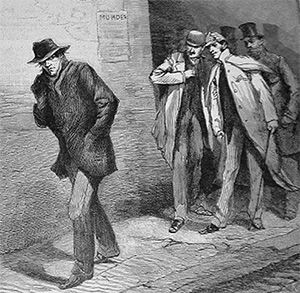
One of a series of images from the Illustrated London News for October 13, 1888 carrying the overall caption, "With the Vigilance Committee in the East End". This specific image is entitled "A Suspicious Character".
"With the Vigilance Committee in theEast End" from the Illustrated London News on October 13, 1888 (http://www.historytoday.com/william-d-rubinstein/hunt-jack-ripper)
Citations
Stevenson, Robert Louis, and Martin A. Danahay. The Strange Case of Dr. Jekyll and Mr. Hyde.2nd ed. Peterborough, Ont.: Broadview Press, 2005. Print.
"The Nemesis of Neglect." Punch 29 Sept. 1888: 152. Print.
Other Sources


"Europe PubMed Central." The Whitechapel murders: the case of Jack the Ripper.. N.p., n.d. Web. 27 Oct. 2014. <http://europepmc.org/abstract/MED/7030054>.

"Punch." Google Books. N.p., n.d. Web. 27 Oct. 2014. <http://books.google.com/books?id=MAYDAAAAIAAJ&pg=RA1-PA102&dq=punch+september+1888&hl=en&sa=X&ei=TAhIVIOOBpPnsASIo4GYCg&ved=0CEsQ6AEwBg#v=onepage&q=nemesis%20neglect&f=false>.

Scarf from Queen Victoria's Diamond Jubilee

Artifact: Commemorative Scarf from Queen Victoria's Diamond Jubilee.
Date: 1897
Producer: Unknown
Material: White china silk


What is it?

The artifact I chose is a scarf made in 1897 that was intended to commemorate Queen Victoria’s Diamond Jubilee. The manufacturer of the artifact is unknown but the scarf is made from white china silk. The center of the scarf depicts three images of Queen Victoria. One portrait is from the beginning of her reign, one is from the middle, and one is from the time of the Jubilee. There is script above and below these images. The top portion reads “Her Gracious Majesty Victoria” and the portion below reads, “Queen of Great Britain and Empress of India”. Along the border of the scarf are the names of the 24 countries that were members of the British Empire at the time. A particular focus is given to India, England, Scotland, and Ireland as these countries make up the corners and are particularly embellished with decorative coats of arms.
Context
The Diamond Jubilee was an event celebrated not just in England, but internationally as well. It took place on June 22, 1897 and was a 6-mile procession through the streets of London featuring 17 carriages and representatives from all of Victoria’s dominion countries. Particularly prominent were the Indian cavalry that escorted Victoria’s carriage. In short, the event was a blatant display of imperialism, as Victoria literally paraded her colonies around London in an attempt to show her people, and the rest of the world, how strong the British Empire actually was.
            The images presented on the scarf symbolically reflect these ideas of imperialism and British power. Victoria herself serves as the focal point of the scarf, indicating that she remains the most important part of the empire. In addition, laurel wreaths surround her images and she is depicted wearing crowns and jewelry, reflecting the Empire’s wealth and prosperity. In contrast, the colonies are shown on the outer borders of the scarf, indicating that they are of lesser importance than England. It is also interesting to note which countries were positioned in the corners of the scarf. Scotland, England, Ireland, and India were given special attention and the designs for these countries are especially ornate. It’s possible that these countries were seen as the most relevant and important colonies to England. Scotland and Ireland are close to England geographically and have long histories with England so it makes sense that the English would see them as important. India, however, was a fairly recent acquisition, Victoria was crowned Empress of India in 1877, but it was still seen as important enough to take up a corner of the scarf. This is because India was seen as the “jewel in the crown” and was highly valued by England for the resources it provided. Interestingly, one of the most valued resources extracted from India was silk, since India had access to silk from China. Ironically, this scarf is made from silk that was probably from India. So this scarf, which portrays the imperialistic relationship between England and India, is made from a resource received directly from that imperialism.
            By creating this scarf and then selling it as a souvenir, the manufacturer effectively trivializes the important issues associated with imperialism. England was proud of their colonies and viewed them as possessions, ignoring the harmful effects that their influence had on the colonies. The English were so proud of their vast empire that they purchased and wore a scarf that bragged about their colonial acquisitions.
Relation to Text
In a general sense, the ideas of imperialism represented in the scarf relate to the themes of imperialism that are present in all of the texts we’ve read in the course. Specifically, it connects with The Moonstone, as that novel criticizes the imperialistic relationship between England and India. In the novel, most of the story takes place in England, which reaffirms the assertion on the scarf that England is the central and most important part of the empire. There could also be a connection between the actual Moonstone, which is a cursed Indian jewel, and the idea that India was considered “the jewel in the crown”. In The Moonstone, the jewel is extremely important and valued in India for its religious importance. However, when the English take it, it becomes cursed and is the center of a crime scene. Perhaps Collins is playing with the metaphor of India being a jewel but is suggesting a darker relationship between the two countries. While Collins criticizes the imperial relationship between England and India, the scarf does the opposite.
            I also see a relationship between the ideas presented in the scarf and the philosophy of Herbert Spencer. Spencer argued that it was natural for societies to grow more complex and advanced with time. He writes, “The orderly progress from simplicity to complexity, displayed by bodies-politic in common with living bodies, is a characteristic which distinguishes living bodies from the inanimate bodies amid which they move” (Spencer 9).  He claims it is “orderly” for societies to become more complex. He later distinguishes between savage and civilized societies, arguing that civilized societies continue to grow, “In complexity, our large civilized nations as much exceed primitive savage tribes” (Spencer 9). The imagery on the scarf seems to agree with this idea. Spencer’s theory somewhat justifies the ideas of imperialism. It is likely that the British saw their massive and always expanding empire as natural and even a sign of civilization. If they believed this, then it would have been easy to justify wearing a scarf that blatantly promoted imperialism.

Artifact Link: http://0-library.artstor.org.helin.uri.edu/library/welcome.html#3%7Csearch%7C6%7CAll20Collections3A20victoria20diamond20jubilee%7CFiltered20Search%7C%7C%7Ctype3D3626kw3Dvictoria20diamond20jubilee7Call26geoIds3D26clsIds3D26collTypes3D26id3Dall26bDate3D26eDate3D26dExact3D26prGeoId3D26origKW3Dvictoria20diamond20jubilee7Call